Theory and practice of the photographic art : including its chemistry and optics : with instructions in the practical manipulation of the various processes, drawn from the author's daily practice (1856)
Sparling, Marcus author · London : Houlston & Stoneman, 65, Paternoster Row : Wm. S. Orr and Co., Amen Corner · leaf 30
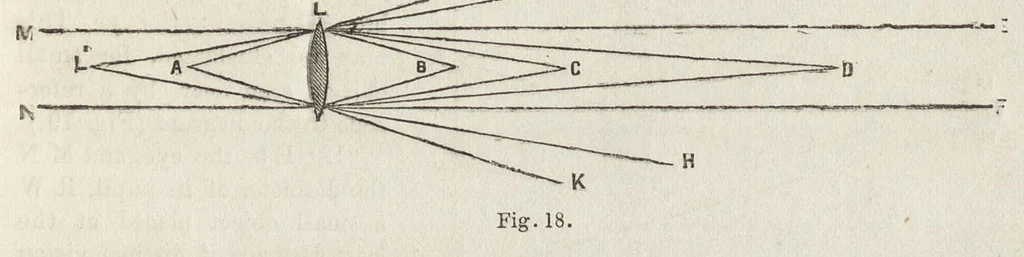
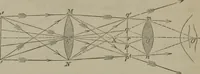
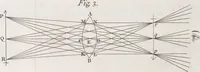
fracted, and have their foci at G and G'', at the same distance from the lens. Those lines which pass through the centre, as £' C G" and F' C G, do not alter their direction, not being refracted. Thus, in whatever way parallel rays pass through a lens, we have a focal point beyond it, be it… … on a comparatively flat or weak lens at L, might meet only at D, or even farther oif, while, with a stronger or more convex lens, they might meet at G or at B. A lens weaker still might only destroy the divergence of the rays, without being able to give them any convergence, or to bend them eaough…