Textile raw materials and their conversion into yarns : (the study of the raw materials and the technology of the spinning process) : a text-book for textile, trade and higher technical schools, as also for self-instruction : based upon the ordinary syllabus and curriculum of the Imperial and Royal Austrian weaving schools (1901)
Zipser, Julius · London : Scott, Greenwood & Son · leaf 479
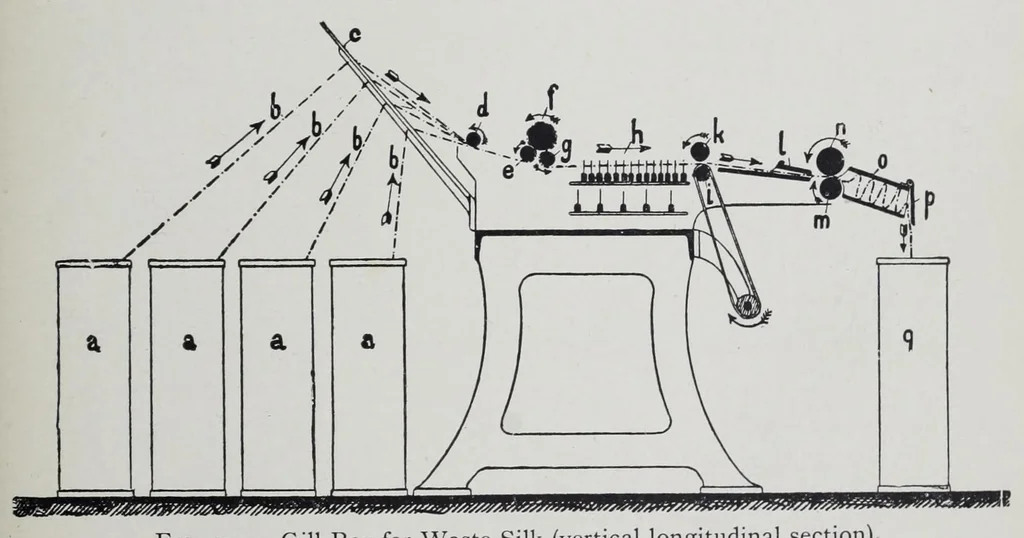
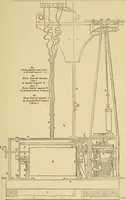
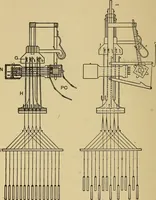
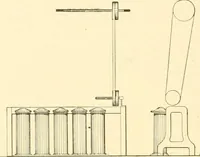
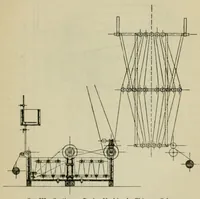
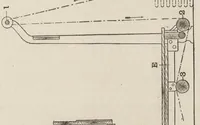
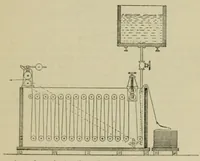
awing. The ribbons formed in the last-named machine are doubled and drawn three or four times to mix, attenuate and regularise them, so that they are fit for conversion into rove. The waste-silk drawing frame employed for this purpose resembles the preceding gill box, and also the corresponding… … Fig. 290.— Gill Box for Waste Silk (vertical longitudinal section). In Fig. 290 the ribbons, h, from the cans, a (about sixteen), are passed over a guide frame, c, then under a guide roller, d, to the receiving rollers, e, /, g, and thence through the gills, h, to the drawing rollers, i, k, the…
Textile fibers · Spinning
Internet Archive · Getty Research Institute · Public domain (published before 1931). Free to use for anything.